
Does Screen Exposure Cause Premature Skin Ageing?
🕐 Read time: 10 min
You did not imagine it.
The dullness. The fine lines that seem to have arrived overnight. The skin that looks tired even after a full night's sleep.
If your working day runs through screens, back to back video calls, reports lit by a laptop glow, a twelve hour shift under fluorescent light, this is not vanity. It is your skin responding to a working life that never quite switches off.
Understanding Screen Exposure Premature Skin Ageing
You know the signs even if you have never put a name to them. The dullness by Wednesday. The fine lines that were not there last year. The uneven tone no amount of concealer quite corrects.
This is screen exposure-induced premature skin ageing, and it comes from repeated contact with the blue light your devices emit every single day. Blue light penetrates further into your skin than most light you are exposed to.
A review published in the Journal of Biomedical Physics and Engineering reports that exposure to light emitted from electronic devices, even for periods as short as one hour, has been shown to increase the generation of reactive oxygen species in human skin cells. These unstable molecules damage the collagen and elastin your skin relies on to stay firm.
This is not one dramatic event. It is cumulative, hundreds of small exposures, every working day, for years, whether you are reading scans, drafting contracts, or running back to back client calls.
Your Working Life Is Not Incidental Exposure
Most articles about blue light talk about screens in general, as if a radiologist reading images for a full shift and someone glancing at their phone on the commute face the same exposure. They do not.
Your working life leaves a specific pattern. Back to back video calls if you lead a team. Hours under theatre or clinic lighting if you are a surgeon or a consultant. A laptop that reopens on the plane if your role has you crossing time zones for client meetings, one climate to another, one screen glow to the next. A laptop that stays open long after contracted hours if you are building something of your own.
Eurofound's 2024 European Working Conditions Survey, covering over 36,000 workers across 35 European countries, found that work intensity has measurably deteriorated for women specifically, alongside a documented rise in sedentary, screen based work. Separately, Deloitte's 2025 Women @ Work report found that almost a third of women, 29%, say they cannot switch off from work.
Neither figure was designed to measure screen exposure directly. But together, rising work intensity and a documented inability to switch off describe a working pattern in which screen time extends well beyond a standard shift for many of you.
Separately again, the research on reactive oxygen species and screen light describes what that sustained exposure does at the cellular level. None of these findings alone proves the exact path from your Tuesday diary to your Tuesday evening skin. But together, they describe a plausible and consistent picture. Your working life and your skin biology are not two separate stories. They are the same one, told from different angles.
For a closer look at how sustained pressure shows up on skin, read What Causes Cortisol Face in Career Women.
How This Actually Happens in Your Skin
The mechanism is simple. Blue light reaches deeper into your skin than many other visible wavelengths, and the research above found this exposure can increase reactive oxygen species even after short periods.
Those molecules attack the collagen and elastin holding your skin firm and even in tone. Over time, that shows up as fine lines, uneven pigmentation, and a duller complexion than the one you had a few years ago.
What makes your exposure different from general environmental exposure is proximity and repetition. You are not passing a screen the way you might pass a polluted street. You sit close to it, often for hours, day after day, whether you are a teacher planning lessons late into the evening or a founder finishing a funding deck at midnight.
What This Looks Like on Your Skin
The signs you may already recognise:
- Fine lines and wrinkles, from collagen and elastin breakdown
- Uneven skin tone and hyperpigmentation, a randomised, controlled clinical study found that repeated blue light exposure produced measurable increases in skin pigmentation, visible within 24 hours of exposure
- Dullness and loss of radiance, from an impaired barrier and reduced hydration
- Dehydration, from disrupted barrier function
These often show first where you are most exposed to your screen, under your eyes, your forehead, your cheeks, your neck.
The Parts of Your Day You Might Not Connect to This
Beyond blue light itself, the way you use your screen carries its own consequences.
Hours angled toward a laptop or a diagnostic monitor can encourage what is sometimes called tech neck, the fine creasing along your neck from repeated forward head posture. Sustained close focus, whether you are reading fine print in a contract or a scan on a monitor, can contribute to tension and fine lines around your eyes.
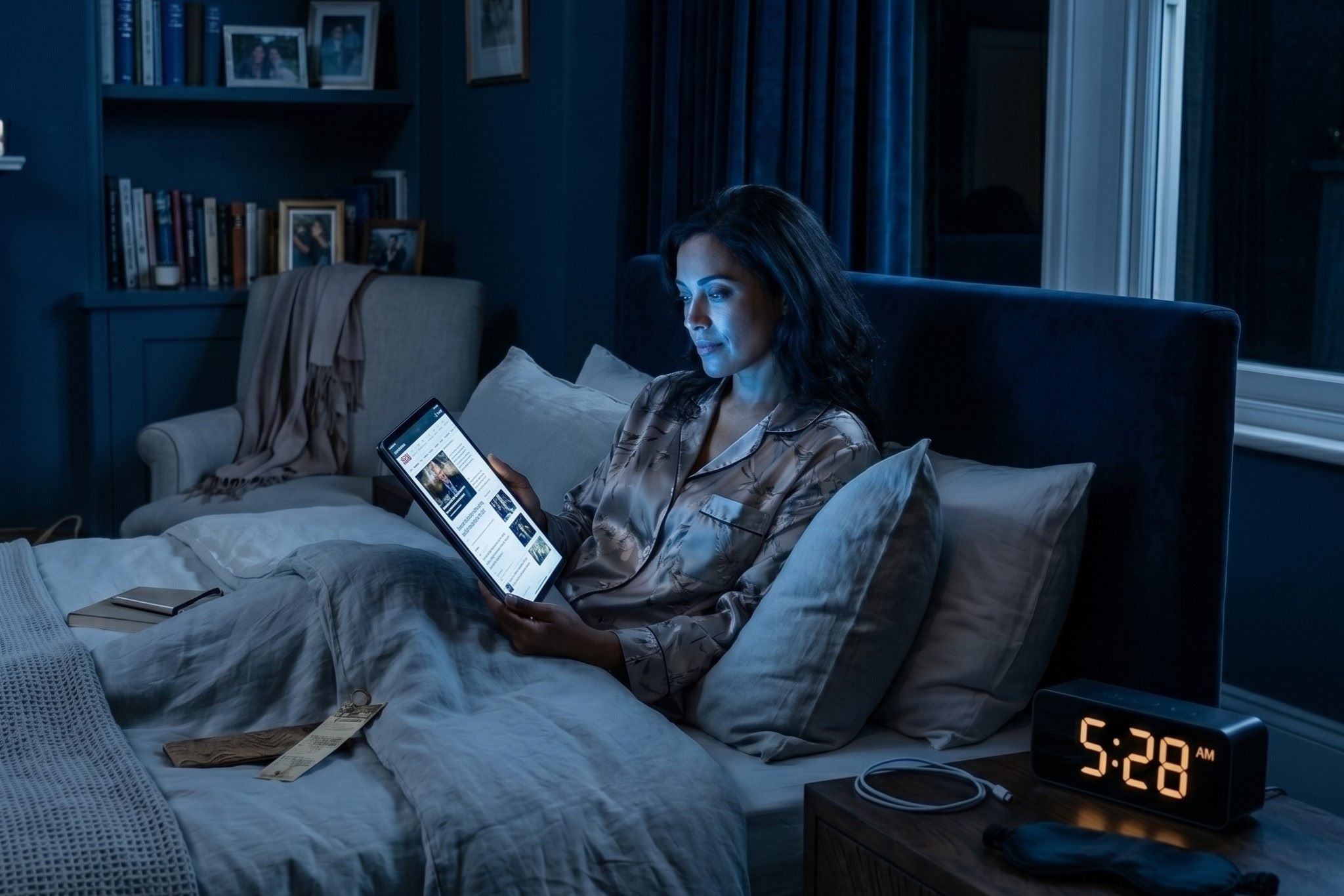
Screen use late into your evening carries a further cost. It can delay the wind down your body needs before sleep, and sleep is when your skin does much of its own repair work.

If you are finishing emails at midnight, or adjusting to a screen glowing at an unfamiliar hour because you have just landed in a different time zone, you are not only exposing your skin to blue light in that moment. You are also shortening the recovery window your skin needs to repair everything it faced earlier in your day.
Beyond Your Screen: The Rest of Your Working Environment
Your screen is one part of a wider picture. Air conditioned offices, recycled air, artificial lighting, city commutes between meetings or clinics, connecting flights and hotel air between cities, all expose your skin to pollutants and irritants beyond your laptop.
This is exactly why antipollution defence and blue light defence belong in the same formulation, not two separate routines competing for space in a day that has room for neither.
What Your Routine Actually Needs
Your routine needs to do three things well. It needs active antioxidant defence to counter the oxidative stress your screen exposure generates. It needs barrier support, since a compromised barrier lets everything else, pollutants, irritants, dehydration, do more damage than it otherwise would. And it needs to fit inside a day that does not have room for ten steps.
Morning protection, evening repair. That is the whole philosophy behind Activate in the morning and Restore overnight, two jobs, not ten products, each one earning its place.
What's Actually In Your Serum
Your Executive Radiance Antipollution Lipid Serum is built around four branded active ingredients, present across both your morning and evening formulations.
SeaBerry Blue™ is built around Haematococcus Pluvialis Extract, one of the richest natural sources of the antioxidant astaxanthin, chosen for the defence it brings to skin under blue light.
BakuLipid™ supports your barrier, restores lipids, and builds resilience. CutiBiome™ supports your skin's microbiome balance, with anti-stress properties that matter when sustained pressure is your daily reality, not an occasional disruption. Immortelle Oil Pro™ supports microcirculation, reduces the appearance of redness, and builds firmness.
What changes between morning and night is the botanical layer built for what your skin needs at that point in your day. Your morning serum, the Executive Radiance Antipollution Lipid Serum with Coffee Extract and Orange Oil, carries Coffee Extract, energising your skin the way your morning coffee energises you, formulated for a day that starts long before the world stirs.

Your evening serum, the Executive Radiance Antipollution Lipid Serum with Vanilla Extract and Orange Oil, carries Vanilla CO2 Extract instead, the soother, as your skin shifts from defending against your day to repairing from it. Orange Oil, present in both, adds brightening uplift throughout.
Two serums, one continuous system. The same four core actives working through your whole day, whether that day is spent in theatre, in court, in a classroom, on a flight between cities, or building your own company from your kitchen table.
Why We Formulate This Way
Most skincare treats screen exposure as an afterthought, a line added to a general routine. If your entire working day happens in front of a screen, it should not be an afterthought. It should be the starting point.
This is Workplace Skin Intelligence, formulating from the documented reality of your working life rather than a skin type. A consultant, a radiologist, a barrister, a founder who travels for every client meeting, do not share a skin type. You share a working pattern, and that pattern is what deserves to shape your formula.
Building This Into Your Day
Consistency matters more than complexity. Apply your Coffee Serum before your first call, not as an afterthought once your day is already underway. Where you can, build in small breaks that shift your eyes and posture away from your screen. Protect your evening wind down where possible, and apply your Vanilla Serum as part of that transition.
A few things that help alongside your serum:
- Set up your workstation to ease posture strain and reduce tech neck
- Build in brief screen breaks where your schedule allows
- Practise stress management, mindfulness, movement, whatever fits your life, since sustained pressure compounds everything your screen already does to your skin
- For the exposure you cannot reduce, your demanding day itself, that is exactly what your Coffee Serum and Vanilla Serum are formulated to defend against
You do not need to choose between the career you have built and the skin you want to see in the mirror. You need a system formulated for the life you actually lead.
Skin strategy. Not just skincare.
Dame Jo!® | Skin strategy. Not just skincare.
Frequently Asked Questions
How does occupational screen exposure contribute to premature skin ageing?
Occupational screen exposure means close range, repeated, sustained contact with blue light, hours of video calls, screens read at arm's length, often for a full working day. This exposure increases reactive oxygen species in your skin cells, damaging collagen and elastin over time and contributing to fine lines, uneven tone, and dullness.
What skincare ingredients protect against blue light from screens?
Your Executive Radiance Antipollution Lipid Serum is built around four branded active ingredients formulated for exactly this exposure. SeaBerry Blue™ brings astaxanthin, chosen for the antioxidant defence it supports under blue light. BakuLipid™ supports barrier restoration and resilience. CutiBiome™ supports your microbiome balance and carries anti-stress properties. Immortelle Oil Pro™ supports microcirculation and firmness.
Can I prevent skin ageing caused by prolonged screen time without reducing screen exposure?
For most of you, meaningfully reducing screen time is not realistic given the demands of your role. Dame Jo!® was built on that premise rather than against it. Targeted antioxidant defence, applied consistently, morning and night, is a more practical strategy than relying on reduced exposure.
What is Workplace Skin Intelligence and how does it help my skin?
Workplace Skin Intelligence is our approach to formulation, building your skincare from the documented reality of your working life rather than starting from skin type alone.
How does workplace stress affect my skin ageing alongside screen exposure?
Rising work intensity and an inability to switch off, both separately documented by Eurofound and Deloitte, extend screen exposure well beyond standard hours for many of you. Separately, research on reactive oxygen species confirms what sustained exposure does at the cellular level. We address this combined reality as an integrated skin strategy.
For more information on the biological effects of blue light on skin, visit the Journal of Biomedical Physics and Engineering, explore workforce related data at Eurofound and Deloitte Women @ Work, and see the clinical findings on blue light and pigmentation at onlinelibrary.wiley.com/doi/10.1111/ics.12637.