
What Your Working Week Is Actually Doing to Your Skin
🕐 Read time: 8 min
Your face on a Monday morning and your face on a Friday evening are not running on the same reserves. Same person. Same skin. Same routine. But your skin has been somewhere across that week and it carries the record of every hour.
That is not a metaphor. It is biology.
The dullness, the sensitivity, the fine lines appearing faster than they should, the breakouts that come right before a big presentation. None of that is random. None of it is bad luck. It is your skin doing exactly what it is designed to do: keep an honest record of everything your week has asked of you.
This is not about vanity. It is about understanding the body you are living in.

Your Skin Has a Job That Never Clocks Off
Most people think of skin as something that just sits there. A surface. A covering. It is not.
Your skin is the largest organ in your body and it works every single hour of every single day. It has two main jobs. During the day it protects you. At night it repairs you.
The protection job is enormous. Your skin stands between you and everything your environment throws at it. Pollution. Dry air. Artificial light. Temperature changes. Bacteria. Chemical residue. It filters, blocks, and absorbs all of it without ever asking you to notice.
The repair job is equally important. While you sleep, your skin gets to work replacing old tired cells with fresh new ones. Think of it like changing a worn-out light bulb. The old one still works but it is dim. The new one is bright. Your skin does this naturally every night, when given the chance.
But when your week has been relentless, both jobs suffer. The protection job gets overwhelmed. The repair job gets cut short. And by Friday your skin is running on a week's worth of unfinished work.
That is not your skin failing you. That is your skin telling you the truth about your week.
The Environments Career Women Work In Were Not Designed With Skin In Mind
Here is something nobody puts in a job description.
The environments that career women spend the majority of their working hours in are among the most demanding environments that skin can face. Not because of any single thing. Because of the combination of everything happening at once.
Whether you work in a corporate office, a hospital ward, an aircraft cabin, a television studio, a retail floor, or a factory floor with industrial lighting, your skin is dealing with conditions that work against it every single day.
Dry Air
The air inside most professional environments is significantly drier than the air your skin needs to stay healthy and balanced. A global study published in the peer-reviewed journal Indoor Air, which measured humidity levels across 43 office buildings in six countries including the UK and the US, found that 42% of measurements taken during working hours fell below 40% relative humidity. As a general guideline, skin holds its moisture balance best in indoor humidity of around 40 to 60%.
Think of your skin like a sponge. In a moist environment it stays plump, soft, and flexible. In a dry environment it slowly loses its water. Every hour you spend in low-humidity air, your skin is losing moisture faster than it can replace it. By the time you leave work it is drier, tighter, and more sensitive than when you arrived.
This happens in offices. It happens in hospitals where strict climate control keeps humidity consistently low. It happens in aircraft cabins, where the air is drier than most deserts.
While you are presenting your quarterly numbers, your skin is quietly dehydrating.
Blue Light
Every screen you look at emits blue light. Your laptop. Your monitor. Your phone. The overhead LED lighting in your workspace. The medical equipment screens in a hospital. The studio lighting on a television set. Research published in the Journal of Cosmetic Dermatology has reported that high-intensity blue light penetrates the skin more deeply than the UVB rays in sunlight.
When blue light reaches the deeper layers of your skin it triggers the production of free radicals. Free radicals are unstable molecules that behave like tiny sparks inside your skin cells. They damage healthy cells, break down the proteins that keep skin firm, and trigger inflammation. Over days, weeks, and years of daily professional exposure the effects accumulate.
The distinction that matters is not intensity. It is protection. You put on sunscreen before you go outside. Nobody told you to protect your skin from your laptop. And across a full working day, screen exposure accumulates in a way a glance at your phone does not.
While you are reviewing documents before the next meeting, your skin is absorbing another hour of blue light it has no defence against.
Pollution and Particulate Matter
City air, hospital corridors, industrial environments, and even heavily air-conditioned buildings contain microscopic particles that land on the skin throughout the day.
Think of tiny invisible grains of sand so small you could fit thousands of them on the head of a pin. They float in the air around you. They land on your skin. And when they do, they trigger your skin's alarm system.
That alarm system is called inflammation. In small doses inflammation is useful. It is how your skin fights threats and repairs damage. But when it is triggered repeatedly every day by a constant stream of incoming particles, it stops being useful and starts wearing your skin down. The result over time is redness, uneven tone, and a face that looks more reactive and sensitive than it used to.
While you are walking between the car park and your building, your skin is already dealing with the first wave of the day.
This combination of dry air, blue light, and particulate matter is not a collection of separate problems. It is a single, sustained assault on your skin that follows the same pattern every working day. At Dame Jo!, we call this the Professional Skin Stress Axis. It is the documented relationship between the career woman's professional environment and what that environment does to her skin over time. Understanding the axis is the first step to building a skincare system that actually responds to it.
What Happens Inside Your Skin After a Full Week

By Friday something very specific has taken place inside your skin.
Your skin is held up by two things: collagen and elastin. Think of collagen as the scaffolding of a building. It is the structure that keeps everything firm and lifted. Think of elastin as a rubber band woven through that scaffolding. It is what allows your skin to stretch and spring back.
When your skin is under sustained stress from dry air, blue light, pollution, and a shortened repair window at night, both get gradually worn down. The scaffolding weakens. The rubber band loses some of its spring. The result is visible.
Around the eyes and jaw you notice puffiness. This happens because when the body is under stress, circulation slows and fluid that should be moving away from the face sits longer than it should. Like water pooling when a drain is blocked.
Your skin tone looks uneven. The stress response disrupts the cells responsible for keeping your skin's natural colour consistent and bright.
Your skin feels more sensitive. The protective layer on your skin's surface has been compromised by a week of dry air and external stress. It is thinner than it should be. More things get through that should not.
Your glow is gone. Your skin is constantly replacing old cells with fresh new ones, a process called cell renewal. Think of it as your skin's housekeeping. When your skin is stressed and your sleep is shortened, this process slows down. The fresh bright cells do not make it to the surface quickly enough. The older, duller ones stay longer. The result is a face that looks flat and lacks its usual light.
None of this is your skin type. All of this is your week.
What Skin Strategy Actually Looks Like
Your skin does not need more products layered on top of the problem. It does not need a longer routine squeezed into a morning that is already too full.
It needs a system built around what your working week actually does to it.
This is what we call Emotional Dermatology. It is the founding philosophy behind every Dame Jo! formula. Formulation and aroma working together to support not just the surface of your skin but the full experience of the woman living in it. When your skincare understands your week, it stops being a task and becomes a moment of return.
If the root cause is sustained environmental stress, a compromised barrier, and a shortened overnight repair window, then the answer starts with formulations that address all three. Barrier support. Antioxidant defence against blue light and pollution. Anti-inflammatory actives that allow the skin to find its baseline again. And simplicity, because more products do not solve a stress-driven skin problem. They add more processing for skin that is already overloaded.
Dame Jo! was formulated for exactly this reality.
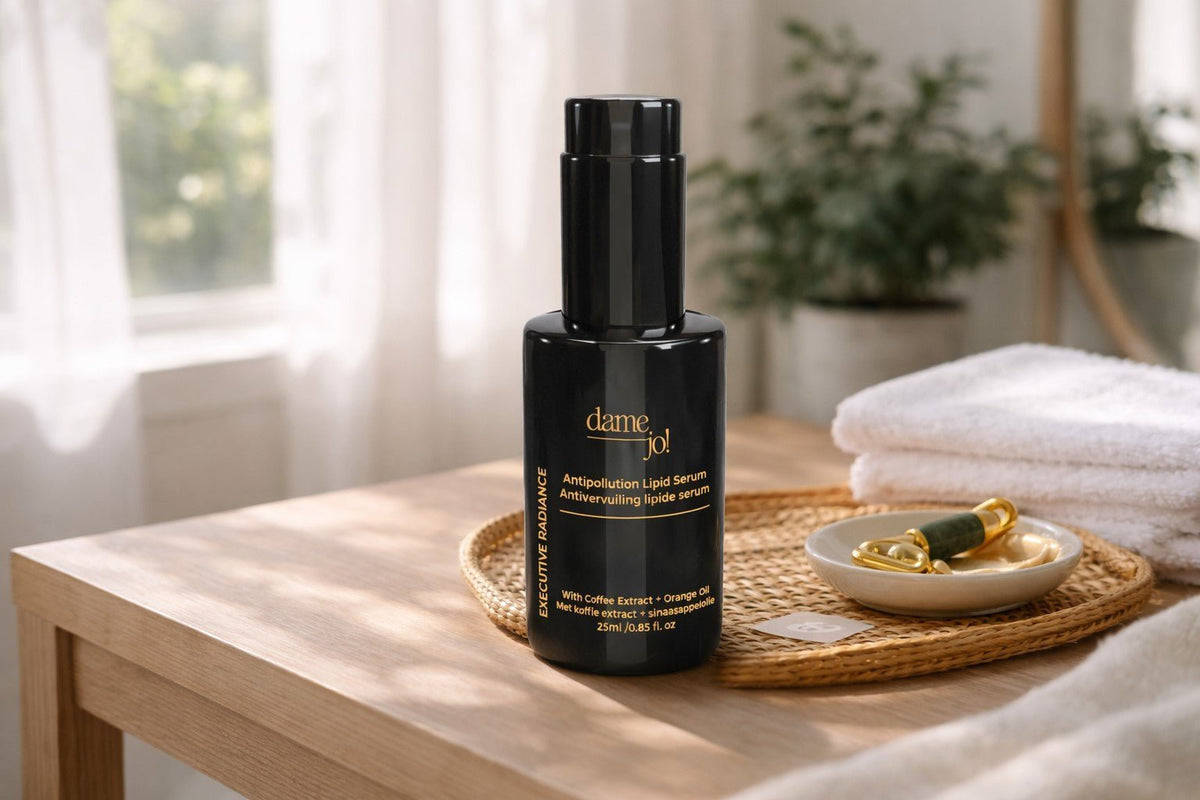
The Executive Radiance Antipollution Lipid Serum with Coffee Extract and Orange Oil activates and protects in the morning. It prepares the skin for the day it is actually about to have. The Executive Radiance Antipollution Lipid Serum with Vanilla Extract and Orange Oil restores and renews at night. It supports the repair window your skin depends on. Two formulas. One complete 24-Hour Lipid System. Every ingredient chosen for function, not trend.

Her time is her most valuable asset. She never has to choose between her ambition and herself.
This is skin strategy. Not skincare.
Frequently Asked Questions
Why does my skin look dull and tired by the end of the working week?
Your skin renews itself slower when you're stressed and the air is dry. Old, dull skin cells stay on the surface longer instead of clearing away. By Friday, that build-up shows.
Does stress really cause skin problems, or is that just something people say?
It's real. The American Academy of Dermatology says stress hormones increase the amount of oil your skin makes, which is why breakouts often follow a hard week.
Can office air conditioning actually dry out my skin?
Yes. A study checked the air in 43 office buildings across six countries. Almost half the readings were too dry for healthy skin.
Why does my face look puffy after a stressful week?
Stress slows down blood flow in your face. Fluid that should drain away sits there longer, a bit like water backing up when a drain is blocked.
Does blue light from my laptop and phone actually damage skin, or is that overblown?
It depends how much exposure you get. A quick glance at your phone isn't the issue. Hours of close screen time every day is different, because blue light reaches deeper into skin than the UVB in sunlight does.